


Every parent wants their child to be prepared for the future. But in 2026, that future is arriving faster than most school curricula can keep up with. Artificial intelligence is no longer a specialist subject it is reshaping every industry, every workplace, and every career path that today's children will eventually enter. The families who recognise this early and find the best AI courses for their children are giving them a genuine head start, not just academically but in life.
Why School Alone Is Not Enough
Mainstream school education has made progress in introducing digital literacy, coding, and computational thinking. But structured, practical AI education the kind that builds real understanding and hands-on capability is still rare in standard curricula. Most schools are working with limited time, limited resources, and teachers who need more support to deliver AI concepts with confidence and depth.
This gap is precisely why after school classes for kids have become one of the fastest-growing areas in enrichment education. Parents are no longer waiting for the system to catch up. They are supplementing their child's learning with structured programs that deliver what classrooms currently cannot: project-based AI learning, ethical reasoning, and real digital confidence.
What Makes an AI Course Worth Enrolling In
Not all AI programs are created equal. When parents search for the top AI courses for their children, they should be asking a specific set of questions before committing to any program.
Does the course teach concepts or just tools? A program that only shows children which buttons to click on an AI platform is not teaching AI literacy. The best AI courses teach children how machine learning works, why data quality matters, and how to think critically about every output they receive.
Is ethics built into the curriculum? Responsible use is not a bonus module it should be woven through every session. Children need to understand bias, fairness, and when human judgement must override an AI recommendation. Programs that skip this are missing the point entirely.
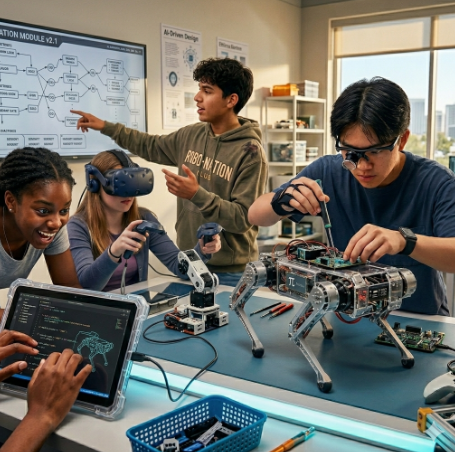
Does the child build something real? Passive learning does not stick. The most effective programs are project-based, where students create classifiers, chatbots, recommendation models, and decision-tree tools that they can actually demonstrate and be proud of.
Is it age-appropriate? AI concepts can be introduced to children as young as four or five with the right approach. But the pathway for a seven-year-old is very different from the pathway for a fourteen-year-old. Top programs place students carefully and build confidence at the right pace for each age group.
After School Classes vs Holiday Camps: Which Is Right for Your Child?
One of the most common questions parents ask when exploring AI education is whether weekly after school classes or intensive holiday camps deliver better results. The honest answer is that they serve different purposes and often work best together.
After school classes for kids are ideal for steady, compounding progress. A child who attends weekly sessions over a full term builds skills layer by layer, revisiting concepts, improving projects, and developing genuine confidence that deepens over time. The routine also reinforces learning in a way that a single intensive cannot replicate.
Holiday camps, on the other hand, are excellent entry points. They create fast momentum through immersive, project-led sessions compressed into a few days or a week. Children who attend a holiday camp often arrive at after school classes with far more enthusiasm and context than those starting cold. Many families use camps to spark their child's interest, then move into regular weekly classes for long-term capability building.
Why the School of AI at Pure Minds Academy Stands Out
For families in Dubai looking for the best AI courses delivered with structure, safety, and genuine educational depth, Pure Minds Academy's School of AI offers exactly that combination. Designed for children aged 4 to 16, the programs span beginner foundations all the way through to Python-based machine learning projects for older learners.
What sets it apart is the philosophy behind it. At Pure Minds Academy, AI is taught as a practical skill rooted in critical thinking not as a shortcut or a productivity hack. Students learn what AI can do, where it fails, and how to use it responsibly. Educators and parents are kept informed and in control throughout, with transparent progress tracking and clear guardrails around how AI tools are used.
Whether your child is completely new to the subject or already curious and ready to go deeper, there is a structured pathway that meets them where they are and builds from there.
The Bottom Line for Parents
The children who thrive in an AI-driven world will not just be the ones who use the tools most often. They will be the ones who understand how those tools work, question their outputs, and apply human judgement where it matters most. That combination of technical literacy, ethical reasoning, and creative problem-solving is exactly what the best AI courses are designed to build.
After school classes for kids are no longer a nice-to-have. For parents thinking about the decade ahead, they are one of the most meaningful investments available.
Explore structured AI programs for children aged 4–16 at Pure Minds Academy's School of AI Saturday classes and holiday camps available in Dubai.

 Turkish