


Introduction
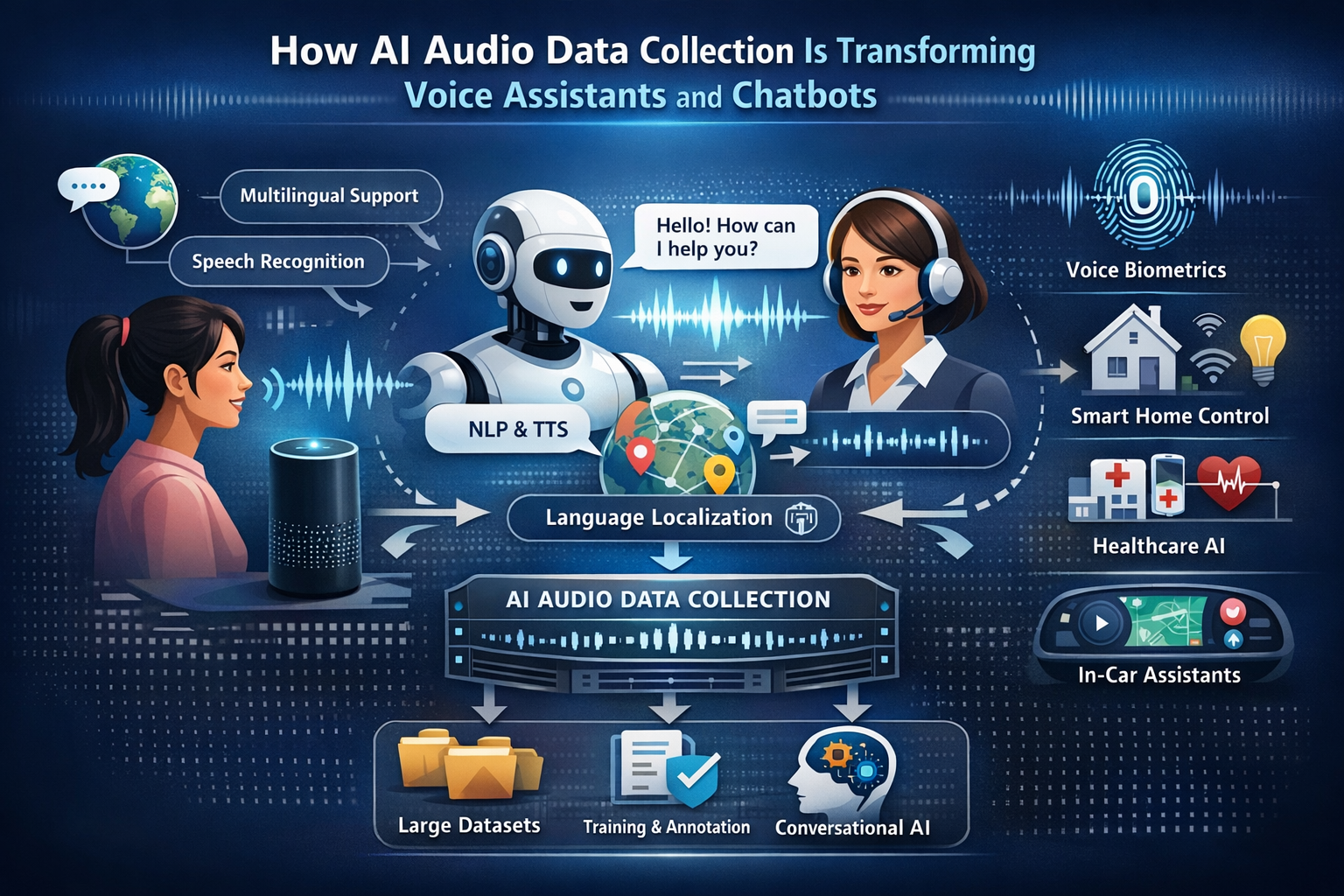
The way humans interact with technology is changing rapidly. Typing and tapping are no longer the only methods of communication with digital systems. In 2026, voice has become one of the most natural and preferred interfaces across industries. From virtual assistants and smart devices to customer support and healthcare applications, intelligent communication is increasingly powered by voice.
Behind this transformation lies a process that rarely receives the attention it deserves AI Audio Data Collection.
While sophisticated algorithms and advanced language models often dominate discussions around artificial intelligence, the reality is much simpler. No voice AI system can perform effectively without reliable and diverse audio data. The growth of intelligent communication depends not only on smarter technology but also on smarter data.
“Voice AI may capture attention, but data is what gives it intelligence.”
AI Audio Data Collection is becoming the foundation of this voice revolution, helping AI systems understand human communication in ways that were once impossible.
Why Is Voice AI Expanding So Rapidly in 2026?
Voice technology is no longer limited to digital assistants. Businesses are integrating voice into nearly every aspect of customer interaction and operational efficiency.
Several factors are accelerating this growth:
-
Increased use of voice-enabled devices
-
Growing popularity of conversational AI
-
Rising adoption of voice search
-
Demand for multilingual digital experiences
-
Advancements in natural language processing
Users now expect faster and more natural communication with machines. This expectation is pushing companies to develop AI systems capable of understanding speech with greater precision.
However, this progress depends heavily on AI Audio Data Collection.
“The success of voice AI is determined long before deployment it begins during data collection.”
What Is AI Audio Data Collection?
AI Audio Data Collection refers to the process of gathering, organizing, and preparing voice recordings to train artificial intelligence systems.
These datasets typically include:
-
Human speech samples
-
Multiple languages
-
Regional accents and dialects
-
Emotional tones and speech patterns
-
Environmental and background sounds
-
Real conversational interactions
The objective is to train AI systems to understand how people naturally communicate rather than relying on scripted or artificial speech.
AI Audio Data Collection creates the learning foundation that allows machines to recognize, interpret, and respond to voice commands and conversations.
How Does AI Audio Data Collection Power Intelligent Communication?
Can AI Truly Understand Human Speech Without Quality Data?
The simple answer is no.
Artificial intelligence does not automatically understand language. It learns through exposure to vast amounts of training data. AI Audio Data Collection provides this training foundation.
High-quality datasets help AI systems:
-
Identify words accurately
-
Understand pronunciation variations
-
Recognize context
-
Process natural conversational flow
-
Reduce recognition errors
Without diverse datasets, even advanced AI models struggle with real-world communication.
Highlighted Insight:
“Better voice experiences begin with better data experiences.”
Why Is Diversity Important in AI Audio Data Collection?
Human communication is incredibly diverse. People speak differently based on:
-
Geography
-
Culture
-
Age
-
Language
-
Emotional state
-
Social environment
This diversity creates challenges for voice AI.
AI Audio Data Collection addresses these challenges by incorporating speech from different demographic and linguistic backgrounds.
For example, a customer in India may switch between Hindi and English during a conversation, while a UK speaker may use entirely different pronunciation and vocabulary patterns.
If AI systems are trained on limited datasets, they fail to deliver accurate results.
“Inclusive data creates inclusive technology.”
This is why multilingual and accent-rich AI Audio Data Collection has become essential for global AI systems.
How Is AI Audio Data Collection Improving Speech Recognition?
Speech recognition has improved dramatically over the last decade.
Earlier systems often struggled with:
-
Background noise
-
Fast speech
-
Strong accents
-
Informal conversation
Modern AI systems perform better because AI Audio Data Collection now focuses on real-world communication.
This includes:
-
Noisy environments
-
Natural pauses and interruptions
-
Multiple speakers
-
Device-specific audio conditions
By training systems using realistic audio samples, developers can create AI capable of performing effectively in everyday situations.
Highlighted Insight:
“Speech recognition accuracy is no longer driven by algorithms alone it is driven by data quality.”
What Role Does AI Audio Data Collection Play in Conversational AI?
Conversational AI is becoming central to digital communication.
Businesses use conversational AI for:
-
Customer service automation
-
Voice assistants
-
Smart home systems
-
Virtual healthcare support
-
Interactive education platforms
However, successful conversations require more than word recognition.
AI systems must understand:
-
Intent
-
Tone
-
Sentiment
-
Conversational context
AI Audio Data Collection enables this by exposing AI models to authentic speech patterns and emotional variations.
This allows voice systems to respond naturally and intelligently.
Why Are Businesses Investing More in AI Audio Data Collection?
Modern businesses recognize that voice is becoming a competitive advantage.
Companies are increasingly investing in AI Audio Data Collection because it helps them:
-
Improve customer experience
-
Reduce support costs
-
Automate communication
-
Expand into multilingual markets
-
Build scalable AI products
Voice AI is no longer viewed as an experimental technology.
It is now part of digital transformation strategies worldwide.
“Businesses that invest in voice intelligence today are preparing for tomorrow’s customer expectations.”
Which Industries Are Driving the Voice AI Revolution?
The impact of AI Audio Data Collection extends across multiple sectors.
Customer Support
AI-powered voice systems help businesses:
-
Automate customer queries
-
Analyze conversations
-
Detect customer sentiment
-
Improve response times
Healthcare
Healthcare organizations rely on voice AI for:
-
Medical transcription
-
Voice-enabled documentation
-
Patient communication systems
Accurate AI Audio Data Collection is critical in handling medical conversations.
Automotive Industry
Modern vehicles increasingly include:
-
Voice navigation
-
Hands-free controls
-
Driver assistance systems
Voice-enabled driving experiences depend heavily on reliable audio datasets.
Banking and Financial Services
Financial institutions use voice AI for:
-
Voice authentication
-
Fraud prevention
-
Automated customer support
AI Audio Data Collection supports both accuracy and security in these systems.
What Challenges Still Exist in AI Audio Data Collection?
Despite rapid progress, several challenges remain.
Data Privacy
Voice recordings may contain personal information, requiring secure and compliant collection practices.
Annotation Complexity
Audio data must be labeled accurately.
This involves:
-
Speech transcription
-
Speaker identification
-
Emotion tagging
-
Intent recognition
Poor annotation can weaken AI performance.
Dataset Bias
Limited diversity may cause AI systems to perform unevenly across languages and demographics.
Scalability
Collecting large-scale multilingual datasets remains time-intensive.
“The future of intelligent communication depends on solving data challenges, not avoiding them.”
How Can Businesses Build Stronger Voice AI Systems?
To build reliable voice systems, organizations should prioritize:
-
Diverse audio collection
-
Real-world conversational data
-
Multilingual datasets
-
High-quality annotation
-
Continuous model improvement
Many organizations partner with experienced providers to build scalable and accurate AI Audio Data Collection pipelines.
A strategic approach to data improves both AI performance and business outcomes.
Final Thoughts
The voice AI revolution is not being powered by algorithms alone. It is being driven by the quality and intelligence of the data used to train these systems.
AI Audio Data Collection has become the invisible infrastructure behind intelligent communication, enabling machines to understand language, emotion, and context with increasing sophistication.
From customer service and healthcare to banking and mobility, industries are entering an era where voice interaction is becoming standard rather than optional.
“The future of communication belongs to AI systems that do more than hear words—they understand people.”
As voice technology continues to evolve in 2026 and beyond, businesses that invest in strong AI Audio Data Collection strategies will be better positioned to lead the next generation of digital communication.
Frequently Asked Questions
What is AI Audio Data Collection?
AI Audio Data Collection is the process of gathering and organizing voice recordings to train AI systems for speech recognition, conversational AI, and intelligent communication.
Why is AI Audio Data Collection important for voice AI?
It helps AI systems understand languages, accents, emotions, and real-world speech patterns, improving performance and user experience.
Which industries benefit from AI Audio Data Collection?
Industries such as customer support, healthcare, banking, automotive, and smart technology rely heavily on voice-enabled AI systems.
How does AI Audio Data Collection improve speech recognition?
It provides diverse and realistic training data that helps AI understand natural speech, reduce errors, and perform effectively in real-world environments.
What are the biggest challenges in AI Audio Data Collection?
Challenges include privacy concerns, annotation complexity, scalability, and maintaining diverse and unbiased datasets.

 Turkish