


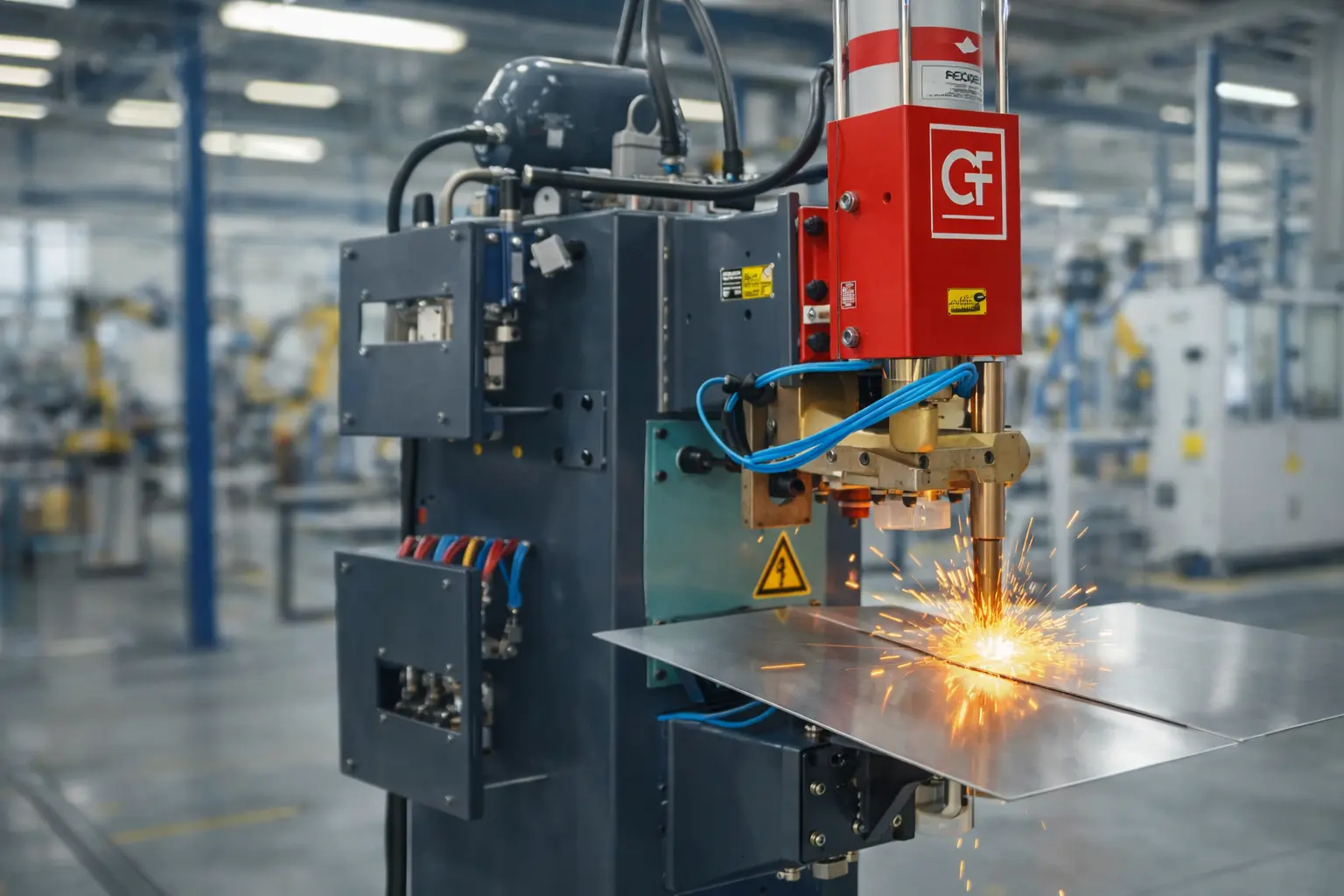
In modern manufacturing, the resistance welder has become a cornerstone of high-speed, high-precision metal joining. From automotive body assembly to electrical busbars and appliance manufacturing, this technology delivers fast, clean, and repeatable welds without filler materials or open flames.
For OEMs, production engineers, and automation integrators, understanding how a resistance welder works and when to use it is essential for optimizing productivity, weld quality, and cost efficiency.
Heron Welder, a global leader in industrial joining systems, designs advanced resistance welding solutions including MFDC spot welders, capacitor discharge welders, projection systems, and fully automated production lines tailored for demanding industrial environments.
What Is a Resistance Welder?
A resistance welder is a machine that joins metals by applying pressure and high electrical current through electrodes. The heat generated at the contact interface (due to electrical resistance) melts the material locally, forming a strong metallurgical bond once cooled.
The core principle is simple yet powerful:
- Electrical current flows through metal sheets
- Resistance at the joint generates heat
- Localized fusion creates a solid weld nugget
This process is widely used because it is fast, clean, and highly repeatable, making it ideal for mass production environments.
Working Principle of Resistance Welding
The resistance welding process follows a controlled sequence:
1. Clamping Phase
Two metal parts are pressed together using copper electrodes under controlled force.
2. Current Application
A high current passes through the contact area.
3. Heat Generation
Electrical resistance generates heat at the interface, melting the material.
4. Weld Formation
Once the current stops, pressure is maintained until the molten zone solidifies.
This cycle can take milliseconds in advanced systems like MFDC or capacitor discharge welders.
Types of Resistance Welders Used in Industry
Modern manufacturing does not rely on a single type of resistance welder. Instead, different technologies are used depending on material, thickness, and production needs.
1. MFDC Spot Welding Machines
MFDC (Medium Frequency Direct Current) welders use inverter technology to produce stable, controlled DC output.
Key advantages:
- Extremely stable current control
- Ideal for automation lines
- Excellent for thin sheets and mixed materials
- Reduced energy consumption
These systems are widely used in automotive and appliance industries for precision welding.
2. Capacitor Discharge (CD) Welders
Capacitor discharge welders store energy and release it in a powerful burst.
Key advantages:
- Ultra-fast welding (milliseconds)
- Minimal heat-affected zone
- Excellent for studs, nuts, and projections
- Low distortion on delicate parts
This makes them ideal for heat-sensitive or coated materials.
3. Seam Welding Machines
Seam welders use rotating wheel electrodes to create continuous welds.
Applications include:
- Fuel tanks
- Air-tight containers
- Industrial drums
They are widely used where leak-proof seams are required.
4. Projection Welding Systems
Projection welding concentrates current at predefined raised points on components, ensuring controlled and strong joint formation.
Key Industrial Applications of Resistance Welders
Resistance welders are essential across multiple industries:
Automotive Manufacturing
- Car body panels
- EV battery structures
- Brackets and reinforcements
Electrical Industry
- Busbars
- Terminal connectors
- Copper-aluminum joints
Appliance Manufacturing
- Washing machines
- Refrigerators
- HVAC components
Heavy Fabrication
- Steel frames
- Industrial enclosures
- Structural assemblies
The automotive sector alone uses billions of resistance welds annually due to its speed and consistency.
Advantages of Using a Resistance Welder
Manufacturers prefer resistance welding because it delivers:
High Production Speed
Weld cycles are extremely fast, often completed in milliseconds.
No Consumables Required
No filler wire or shielding gas is needed.
Strong and Consistent Joints
Automated control ensures repeatable weld quality.
Easy Automation Integration
Compatible with robotic arms and production lines.
Clean and Environment-Friendly Process
No open flame, smoke, or arc emissions.
Resistance Welder vs Other Welding Methods
Compared to MIG or TIG welding, resistance welding offers:
| Feature | Resistance Welding | MIG/TIG Welding |
|---|---|---|
| Speed | Very High | Moderate |
| Automation | Excellent | Limited |
| Consumables | None | Required |
| Heat Zone | Localized | Larger |
| Production Use | Mass production | Fabrication/repair |
This makes resistance welders the preferred choice for high-volume industrial manufacturing.
Best Practices for High-Quality Welding
To ensure optimal performance from a resistance welder, engineers should follow key practices:
1. Proper Electrode Maintenance
Clean electrodes regularly to avoid contamination and poor conductivity.
2. Controlled Welding Parameters
Optimize current, pressure, and time according to material thickness.
3. Material Preparation
Remove oil, rust, or coatings before welding for consistent results.
4. Cooling System Efficiency
Maintain electrode cooling to extend tool life and stability.
Heron Welder: Engineering Advanced Resistance Welding Solutions
As a global manufacturer, Heron Welder specializes in designing industrial-grade resistance welding systems built for modern production demands.
Our portfolio includes:
- MFDC spot welding machines
- Capacitor discharge welding systems
- Projection welding equipment
- Seam welding solutions
- Automated welding production lines
Each system is engineered for:
- High precision
- Energy efficiency
- Long-term stability
- Seamless automation integration
From OEM manufacturing to large-scale industrial production, Heron delivers customized welding solutions that improve productivity and reduce operational costs.
FAQs About Resistance Welder
1. What materials can a resistance welder join?
Resistance welders can join steel, stainless steel, aluminum, copper, and coated metals depending on machine type.
2. Is resistance welding suitable for automation?
Yes, it is one of the most automation-friendly welding processes and is widely used in robotic production lines.
3. What is the main advantage of MFDC resistance welding?
MFDC systems provide highly stable current control, resulting in consistent weld quality and reduced energy consumption.
4. Where is capacitor discharge welding used?
It is commonly used for studs, nuts, and heat-sensitive components requiring minimal deformation.
5. How long does a resistance weld take?
Most welds are completed within milliseconds to a few seconds depending on application.
Conclusion
The resistance welder remains one of the most efficient and reliable metal joining technologies in modern manufacturing. Its speed, precision, and adaptability make it indispensable across automotive, electrical, and industrial production sectors.
Whether you need MFDC precision welding, capacitor discharge systems, or fully automated production integration, selecting the right resistance welding solution is critical for long-term efficiency and product quality.
Looking to upgrade your welding line or develop a customized solution?
Contact Heron Welder today to request a quote or speak with our engineering team about tailored resistance welding and automation systems designed for your production needs.

 Turkish