


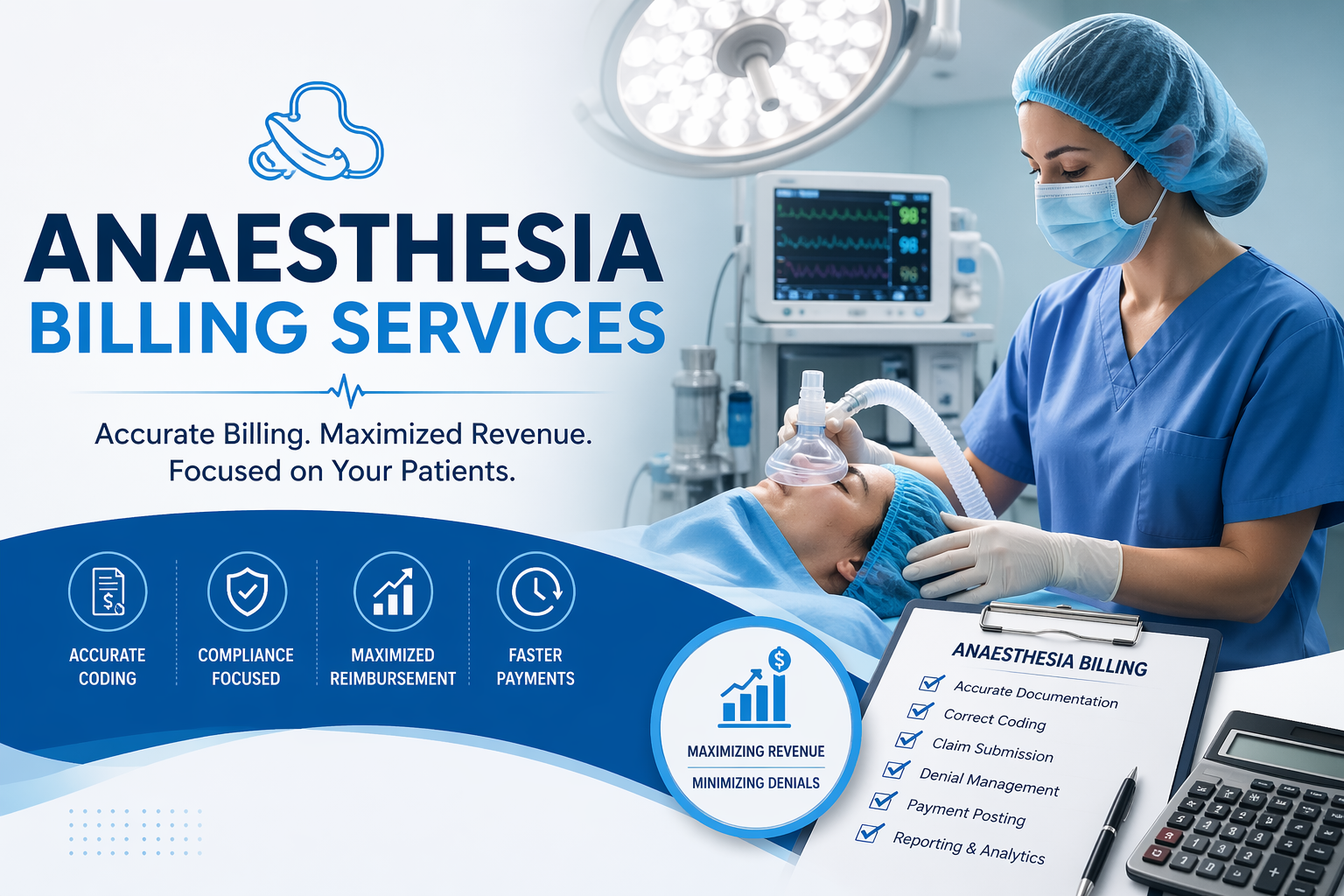
Anesthesia practices operate in one of the most complex billing environments in healthcare. Unlike standard medical billing, reimbursement depends on base units, time units, modifiers, and strict payer rules, making accuracy non-negotiable. Even small documentation errors can trigger claim rejections or underpayments that directly impact cash flow.
Recent industry insights show that anesthesia billing error rates can be as high as 30%+ in poorly managed revenue cycles, and practices may lose 8–15% of annual revenue due to billing inefficiencies and coding mistakes . This is why many providers are turning toward anesthesia billing outsourcing to stabilize revenue, reduce denials, and improve operational efficiency.
Billing challenges in anesthesia practices
The need for anesthesia billing outsourcing is driven by the unique complexity of the specialty. Unlike fee-for-service models, anesthesia reimbursement is highly variable and time-sensitive.
Key challenges include:
- Time-based billing complexity: Every case requires precise tracking of anesthesia start and end times, often calculated in 15-minute increments. Small errors directly reduce reimbursement
- Modifier sensitivity: Incorrect use of modifiers (QX, QK, AA, etc.) leads to immediate claim denials
- High denial rates: Anesthesia claims experience denial rates around 12–20% on first submission, higher than many specialties
- Documentation gaps: Missing pre-op, intra-op, or post-op records often result in payer rejection
- Frequent payer rule changes: Medicare and private insurers frequently update anesthesia billing requirements, creating compliance challenges
- Revenue leakage: Studies show 15–25% of anesthesia revenue can be lost due to billing inefficiencies and underpayments
These issues are not just administrative—they directly reduce profitability and increase financial unpredictability for anesthesia groups.
Choose a billing partner for anesthesia billing outsourcing
Selecting the right partner for anesthesia billing outsourcing determines whether your revenue cycle improves or becomes more complicated. A strong billing partner should function as an extension of your practice.
Look for these qualities:
- Anesthesia specialization: Deep experience in ASA units, time-based billing, and anesthesia-specific CPT coding
- High clean claim rate (95%+): Indicates strong first-pass accuracy and reduced rework
- Advanced coding expertise: Ability to handle modifiers, medical direction rules, and payer-specific logic
- Transparent reporting: Real-time dashboards for AR aging, denial trends, and collection rates
- Denial management system: Dedicated teams that actively work rejected claims instead of simply resubmitting them
- Compliance-first approach: Strong HIPAA safeguards, audit readiness, and documentation standards
- Scalable technology integration: Compatibility with EHR, EMR, and practice management systems
- Revenue-focused pricing model: Clear pricing tied to collections or performance, not hidden fees
Choosing a qualified outsourcing partner is often the difference between consistent reimbursement and ongoing revenue leakage.
Reduce denials in anesthesia billing outsourcing
Denial prevention is the most important outcome of anesthesia billing outsourcing. Effective outsourcing partners implement structured workflows to eliminate common revenue leaks.
1. Standardize anesthesia documentation
Ensure every provider follows a unified format for recording start time, stop time, and intraoperative notes. Inconsistent documentation is a major denial trigger.
2. Improve time unit accuracy
Accurate time tracking is critical because anesthesia billing is time-based. Even minor rounding errors can reduce payable units and trigger payer audits.
3. Use correct modifiers consistently
Modifier errors are one of the fastest causes of claim rejection. Outsourcing teams should enforce strict modifier validation before submission.
4. Verify insurance eligibility upfront
Front-end eligibility checks prevent downstream denials related to coverage issues or missing authorizations.
5. Implement real-time claim scrubbing
Advanced systems identify errors before submission, reducing rejection rates and improving first-pass acceptance.
6. Actively manage denied claims
Denials should not be ignored. Every rejected claim must be categorized, appealed, or corrected within payer timelines.
7. Track underpayments, not just denials
Many practices lose revenue through underpayments rather than outright denials. Outsourcing partners should audit payments against expected reimbursement.
HIPAA compliance and billing technology in outsourcing
When adopting anesthesia billing outsourcing, compliance and technology become critical pillars of security and performance.
HIPAA compliance requirements
Outsourced billing partners must maintain strict compliance standards, including:
- Encrypted data transmission and storage
- Role-based access control for patient data
- Business Associate Agreements (BAA)
- Regular compliance audits
- Staff training on PHI handling
Data security risks are one of the most important concerns in outsourcing, especially since patient information is shared externally. Without proper safeguards, practices risk regulatory penalties and reputational damage .
Technology-driven billing systems
Modern anesthesia billing outsourcing relies on integrated systems that improve accuracy and speed:
- EHR/EMR integration for seamless data capture
- Automated coding assistance for CPT and modifier selection
- Real-time denial tracking dashboards
- AI-based claim scrubbing tools
- Cloud-based reporting for transparency and analytics
Technology reduces manual intervention, which is a leading cause of billing errors and delayed reimbursements.
How 247 Medical Billing Services helps with anesthesia billing outsourcing
247 Medical Billing Services specializes in revenue cycle management solutions designed specifically for complex specialties like anesthesia.
With a focus on accuracy, compliance, and financial performance, the company supports practices by:
- Managing end-to-end anesthesia billing outsourcing workflows
- Reducing claim denials through proactive coding validation
- Improving first-pass claim acceptance rates
- Ensuring HIPAA-compliant data handling and secure systems
- Providing real-time reporting on collections, AR, and denial trends
- Handling payer follow-ups and appeals to recover lost revenue
- Supporting scalable billing operations for single or multi-facility groups
By combining specialty expertise with technology-driven processes, 247 Medical Billing Services helps anesthesia practices reduce administrative burden and focus more on patient care while maintaining consistent cash flow.
Conclusion
The complexity of anesthesia reimbursement makes billing one of the most error-prone areas in healthcare finance. From time-based calculations to modifier accuracy and payer variability, small mistakes can lead to significant revenue loss.
Anesthesia billing outsourcing offers a practical solution by improving accuracy, reducing denials, and strengthening revenue cycle performance. With industry-level denial rates and revenue leakage affecting profitability, outsourcing is no longer just an operational choice—it is a financial strategy.
Partnering with an experienced provider like 247 Medical Billing Services ensures that billing operations are handled with precision, compliance, and accountability.

 English