


In the fast-evolving world of artificial intelligence, the quality of training data directly determines the quality of model outcomes. For computer vision applications, this makes image annotation one of the most critical stages in the AI development pipeline. Among the various annotation techniques available today, polygon labeling stands out as one of the most precise and valuable methods for training advanced vision models.
At Annotera, we understand that not all annotation types deliver the same level of accuracy for every use case. While bounding boxes and semantic segmentation are widely used, polygon labeling becomes indispensable when AI models require detailed object boundaries and minimal background noise. As a trusted data annotation company, we help businesses leverage polygon annotation to improve model precision across complex visual datasets.
Understanding Polygon Labeling in Image Annotation
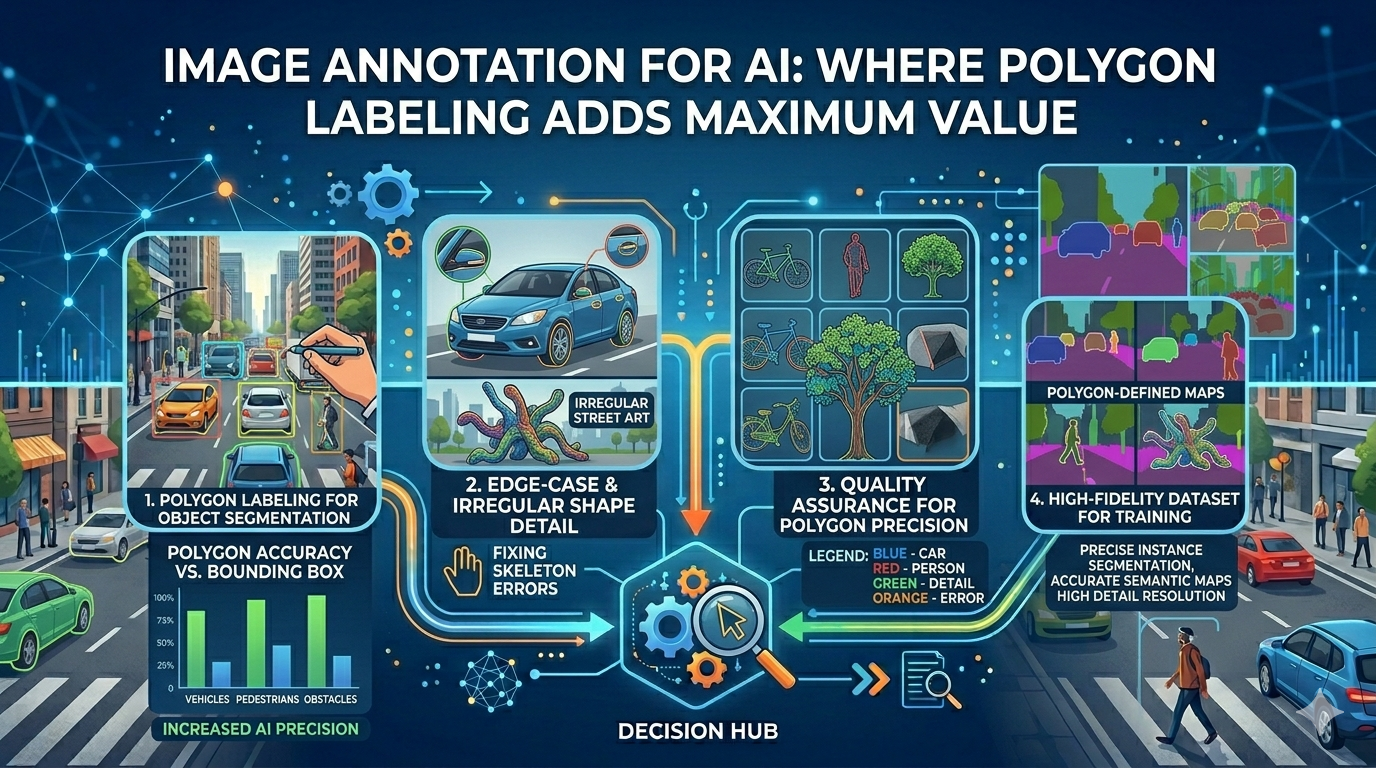
Polygon labeling is a specialized form of image annotation where annotators place multiple points around the exact edges of an object to create a closed shape. Unlike rectangular bounding boxes, polygons follow the actual contours of the object.
This method allows AI systems to learn the exact shape, size, and boundary of objects within an image. It is especially effective for irregularly shaped items that cannot be accurately captured using simple rectangles.
For example, objects such as trees, roads, buildings, human silhouettes, medical organs, or industrial components often require precise outlines. In such scenarios, polygon labeling reduces unnecessary background pixels and improves the learning quality of the model.
Why Polygon Labeling Adds Maximum Value for AI
The real strength of polygon annotation lies in its ability to improve data quality for highly complex computer vision tasks. AI models trained with precisely labeled data perform better in detection, segmentation, and recognition workflows.
1. Better Object Boundary Precision
Polygon labeling accurately traces the edges of an object. This is crucial when the object has an irregular or non-rectangular shape.
For instance, in aerial imagery, buildings, rivers, roads, and agricultural zones rarely fit within square or rectangular boxes. Polygon labels provide a close contour that helps the model distinguish object boundaries more effectively.
This higher precision leads to better prediction outcomes in real-world deployment.
2. Reduced Background Noise
Bounding boxes often include large portions of irrelevant background pixels. These unnecessary visual elements can confuse the AI model during training.
Polygon labeling eliminates this issue by outlining only the object itself. As a result, the model receives cleaner and more relevant training data, which improves classification and detection accuracy.
3. Improved Instance Segmentation Performance
For AI applications involving instance segmentation, polygon labeling is often the preferred choice.
Whether identifying multiple pedestrians in crowded scenes or separating overlapping products on retail shelves, polygons help models distinguish one object from another with greater clarity.
This becomes highly valuable in advanced computer vision systems such as autonomous vehicles and surveillance solutions.
Industries Where Polygon Labeling Delivers Maximum Impact
Polygon annotation is widely used across industries where accuracy directly affects operational outcomes.
Autonomous Vehicles
Self-driving systems rely heavily on accurate visual recognition. Roads, lane markings, vehicles, pedestrians, traffic signs, and sidewalks all contain complex shapes.
Polygon labeling enables AI systems to interpret these irregular boundaries with greater precision, helping improve navigation and safety systems.
Healthcare and Medical Imaging
Medical AI applications require extremely detailed image annotation.
When training models to detect tumors, organs, fractures, or abnormal tissues, polygon labeling offers the precision needed to mark exact anatomical boundaries.
This significantly improves the reliability of diagnostic AI tools.
Retail and E-commerce
Retail AI solutions often use computer vision for product recognition, shelf monitoring, and inventory automation.
Products placed closely together or overlapping on shelves need accurate separation. Polygon labels help identify each product independently, improving stock detection and analytics.
Agriculture and Drone Imaging
Agricultural AI systems use image annotation for crop monitoring, disease detection, and land mapping.
Polygon labeling helps accurately outline crop areas, leaves, fruits, and damaged regions, enabling precise AI-driven farm insights.
When Businesses Should Choose Polygon Labeling
Polygon labeling should be selected when the project demands precision beyond standard object detection.
Businesses should consider polygon annotation when:
- Objects have irregular shapes
- Overlapping objects need separation
- Fine-grained segmentation is required
- Background interference must be minimized
- AI models need higher visual accuracy
As an experienced image annotation company, Annotera helps clients assess which annotation method best suits their AI objectives.
In many enterprise AI workflows, combining polygon labeling with other annotation methods creates the most effective training dataset.
Challenges in Polygon Annotation
Although polygon labeling delivers excellent accuracy, it also requires more time and expertise compared to simpler methods.
Annotators must carefully place multiple points around each object boundary, which makes the process more labor-intensive.
This is where professional data annotation outsourcing becomes highly valuable.
Outsourcing to an expert team ensures:
- Faster turnaround
- Consistent annotation quality
- Scalable workforce support
- Multi-level quality assurance
- Reduced operational costs
For growing AI companies, image annotation outsourcing allows internal teams to focus on model development while annotation specialists handle the data pipeline.
Why Choose Annotera for Polygon Image Annotation
At Annotera, we specialize in delivering high-precision polygon annotation services tailored for modern AI applications.
As a trusted data annotation company, our workflow is built around quality, scalability, and domain-specific expertise.
Our services include:
- Polygon image annotation
- Instance segmentation support
- Multi-object labeling
- Quality-controlled annotation pipelines
- Industry-specific data solutions
Whether you need support for healthcare AI, autonomous systems, retail intelligence, or geospatial analysis, our team ensures accurate annotations that improve model performance.
Our data annotation outsourcing services are designed to help businesses scale AI development without compromising dataset quality.
Final Thoughts
Polygon labeling adds maximum value where AI systems need precision, accuracy, and contextual clarity.
As computer vision models become more advanced, the demand for detailed image annotation continues to grow. Polygon annotation remains one of the most effective approaches for training models that must interpret complex shapes and real-world visual environments.
Partnering with a reliable image annotation company like Annotera ensures your AI models are trained on clean, high-quality data that drives measurable results.
If your project requires precise object boundaries and scalable annotation workflows, image annotation outsourcing with Annotera can help accelerate your AI success.

 English