


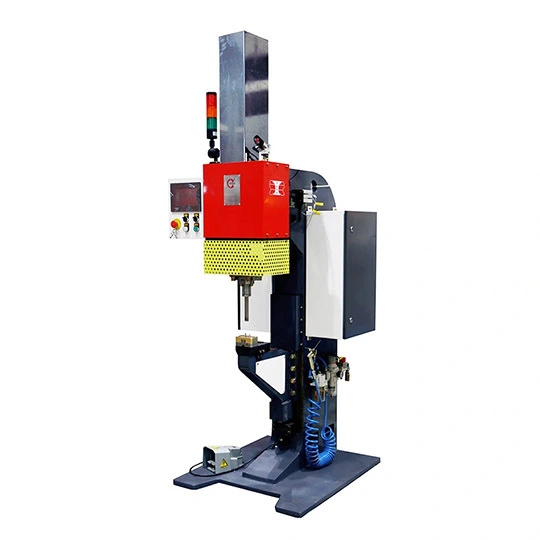
In today’s competitive manufacturing environment, speed, precision, and reliability are critical. Traditional welding methods often struggle to meet the demands of lightweight materials, multi-layer assemblies, and automated production lines. This is where self pierce riveting (SPR) emerges as a game-changer. As a global leader in industrial metal-joining solutions, Heron Welder provides advanced SPR systems that help OEMs, manufacturing engineers, and automation integrators achieve high-quality, efficient, and repeatable results.
In this guide, we explore the principles, applications, advantages, and best practices of self pierce riveting, highlighting why Heron’s SPR solutions are trusted in factories worldwide.
What is Self-Pierce Riveting?
Self-pierce riveting is a mechanical joining process used to fasten multiple layers of sheet metal or dissimilar materials without pre-drilling holes. Unlike traditional riveting, SPR uses a specially designed rivet that pierces the top sheet and flares into the bottom sheet, creating a strong, permanent joint.
Key features include:
-
Cold joining process: Eliminates the need for welding heat, reducing distortion.
-
Multiple material compatibility: Works with aluminum, steel, coated sheets, and composite panels.
-
Automation-ready: Ideal for integration into robotic production lines for high-volume manufacturing.
Heron’s SPR machines are designed for precision and flexibility, ensuring consistent joint quality across various material thicknesses and assembly configurations.
How Self-Pierce Riveting Works
The SPR process involves three main stages:
-
Rivet Feeding and Positioning: The rivet is automatically positioned over the joint area.
-
Piercing and Flaring: A hydraulic or servo-driven press drives the rivet through the top sheet, flaring it into the bottom sheet without penetrating fully.
-
Joint Formation: The flared tail locks the sheets together, forming a mechanically strong joint with excellent shear and tensile strength.
Heron’s SPR machines incorporate high-precision control systems to optimize the force and speed for each material combination, minimizing damage while maximizing joint integrity.
Applications of Self-Pierce Riveting
SPR is widely used across industries where lightweight construction, structural strength, and high-speed production are required. Common applications include:
-
Automotive manufacturing: Joining aluminum body panels, hybrid material assemblies, and structural reinforcements.
-
Appliances and electronics: Securing sheet metal enclosures and internal frames.
-
Aerospace components: Lightweight panel assemblies and composite-to-metal joints.
-
Construction and HVAC: Ductwork, metal furniture, and cladding panels.
By replacing traditional welding or mechanical fastening methods, SPR reduces cycle time, material deformation, and post-processing requirements.
Advantages of Self-Pierce Riveting
-
Material Flexibility: SPR can join different metals and coated surfaces without compromising joint quality.
-
High Strength: Riveted joints exhibit excellent tensile and shear performance.
-
No Heat-Affected Zone: Unlike spot welding, SPR does not create thermal distortion or residual stress.
-
Automation-Friendly: Easily integrated into robotic or CNC production lines for high-volume manufacturing.
-
Environmentally Friendly: Reduces energy consumption compared to heat-based joining methods.
Heron’s SPR systems are engineered to maximize these benefits, delivering consistent performance for complex assemblies.
SPR vs. Traditional Welding
| Feature | Self-Pierce Riveting | Spot/Resistance Welding |
|---|---|---|
| Heat Involvement | Cold process | Heat-intensive |
| Material Compatibility | Multi-metal, composites | Primarily steel/aluminum |
| Distortion | Minimal | Possible thermal distortion |
| Automation | Easily automated | Requires welding robots or fixtures |
| Production Speed | High | Moderate, depends on cooling time |
Choosing SPR over traditional welding often reduces production costs, enhances joint aesthetics, and allows lightweight material usage without sacrificing structural strength.
Best Practices for Effective Self-Pierce Riveting
-
Material Assessment: Ensure top and bottom sheets are compatible in thickness and ductility.
-
Rivet Selection: Choose rivet diameter, length, and hardness based on application requirements.
-
Tooling Maintenance: Regular inspection of dies and punches ensures consistent joint quality.
-
Process Monitoring: Use torque and force sensors to detect misfeeds or incomplete joints.
-
Integration with Automation: Coordinate SPR machines with robotic arms and assembly lines for maximum efficiency.
Heron offers SPR solutions with advanced monitoring and customizable tooling, making it easier for factories to adopt best practices and achieve repeatable results.
FAQs About Self-Pierce Riveting
1. Can SPR join dissimilar metals like aluminum and steel?
Yes. Self-pierce riveting excels at joining dissimilar metals without causing heat-related damage, which is a common challenge in traditional welding.
2. What thickness range can SPR handle?
Typically, SPR can join sheet thicknesses ranging from 0.8 mm to 6 mm, depending on rivet and machine selection.
3. Is SPR suitable for automated production lines?
Absolutely. SPR machines are designed for robotic integration, providing high-speed, repeatable, and precise joining.
4. How does SPR affect corrosion resistance?
Since SPR does not require heat, coated sheets retain their protective layers, minimizing corrosion risk.
5. What industries benefit most from SPR?
Automotive, aerospace, appliance manufacturing, electronics, and metal furniture industries see the most significant advantages from SPR.
Why Choose Heron for Self-Pierce Riveting
Heron Welder has decades of experience delivering high-performance metal joining and automation solutions. Our SPR machines are:
-
Built for precision, reliability, and long-term durability.
-
Fully customizable for specific production requirements.
-
Supported by a global service network for training, maintenance, and technical consultation.
Whether you are integrating SPR into an automotive body line or lightweight appliance assembly, Heron provides the expertise and equipment to enhance efficiency and quality.
Take the Next Step
Optimize your manufacturing process with Heron Welder’s self-pierce riveting solutions. Contact us today to request a quote or consult our experts for a tailored automation and metal-joining solution that fits your factory’s needs.

 English