


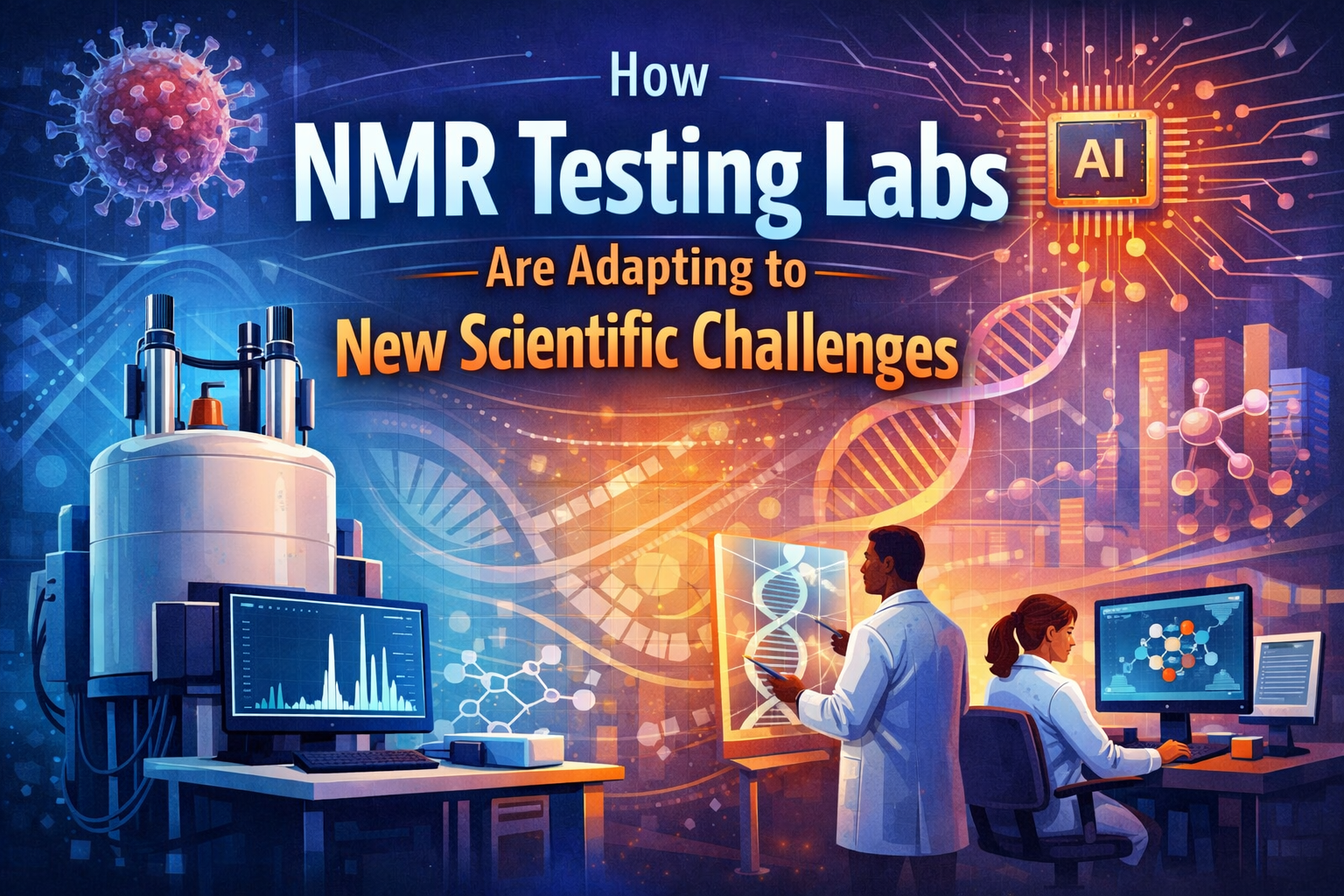
Nuclear Magnetic Resonance (NMR) spectroscopy has long been a cornerstone of analytical science. From pharmaceutical validation to materials research, NMR testing labs play a critical role in ensuring product safety, regulatory compliance, and scientific innovation. But as industries evolve and scientific problems become more complex, NMR laboratories are being pushed to adapt in powerful new ways.
1. Tackling Increasingly Complex Molecules
In sectors like pharmaceuticals and biotechnology, molecules are becoming more structurally intricate. Large biologics, polymers, and advanced materials often present overlapping signals and subtle structural variations that are difficult to interpret.
Modern NMR labs are responding by:
-
Deploying high-field instruments (600–1200 MHz systems)
-
Using cryogenically cooled probes for enhanced sensitivity
-
Implementing multidimensional NMR techniques (2D, 3D, and even 4D experiments)
For example, regulatory standards from organizations like the U.S. Food and Drug Administration increasingly require detailed impurity profiling and structural verification. NMR labs must now provide deeper analytical insight than ever before.
2. Integrating NMR with Complementary Technologies
NMR is powerful, but today’s analytical challenges often require multi-technique workflows. Labs are integrating NMR with:
-
Mass spectrometry (MS)
-
High-performance liquid chromatography (HPLC)
-
X-ray crystallography
-
Infrared (IR) spectroscopy
By combining data sets, labs can deliver comprehensive structural characterization. In pharmaceutical quality control environments aligned with guidelines from the European Medicines Agency, such integration enhances data reliability and regulatory acceptance.
3. Addressing Regulatory and Compliance Demands
Regulatory scrutiny has intensified across industries such as pharmaceuticals, food safety, and chemical manufacturing. Documentation, traceability, and validation are now as critical as analytical precision.
To meet compliance standards set by bodies like the International Council for Harmonisation of Technical Requirements for Pharmaceuticals for Human Use (ICH), NMR labs are:
-
Implementing 21 CFR Part 11-compliant software systems
-
Enhancing data integrity protocols
-
Automating audit trails and reporting
-
Conducting routine instrument performance qualification (PQ)
Digital transformation has become essential for maintaining trust and regulatory approval.
4. Embracing Automation and Artificial Intelligence
Automation is reshaping NMR workflows. Robotic sample changers, automated shimming, and cloud-based spectral analysis tools are improving efficiency and reducing human error.
Artificial intelligence (AI) and machine learning are also making an impact by:
-
Accelerating spectral interpretation
-
Identifying impurities faster
-
Predicting molecular structures
-
Reducing turnaround times
As industries demand faster product development cycles, automation enables NMR labs to scale operations without sacrificing quality.
5. Supporting Emerging Fields: Biologics and Advanced Materials
The rise of biologics, gene therapies, and nanomaterials presents new analytical challenges. Unlike small molecules, biologics such as monoclonal antibodies require advanced structural analysis techniques.
Organizations like the National Institutes of Health support research that increasingly depends on sophisticated NMR capabilities for protein structure determination and biomolecular interaction studies.
To stay competitive, NMR labs are:
-
Expanding biomolecular NMR services
-
Investing in solid-state NMR for materials science
-
Developing expertise in metabolomics and structural biology
6. Enhancing Sensitivity and Speed
Modern scientific challenges often involve low-concentration samples or limited quantities of rare materials. Sensitivity improvements are crucial.
Labs are adopting:
-
Cryoprobes
-
Microcoil NMR technology
-
Hyperpolarization techniques
-
Benchtop NMR for rapid field analysis
These innovations allow labs to extract more data from smaller samples, supporting sustainability and cost-efficiency goals.
7. Adapting to Global Collaboration and Remote Work
The scientific community is more interconnected than ever. NMR labs now frequently operate in global networks, sharing data and collaborating across time zones.
Cloud-based data platforms allow researchers to review spectra remotely, consult experts worldwide, and integrate results into collaborative research pipelines. This shift enhances productivity and accelerates innovation.
8. Strengthening Workforce Expertise
As instrumentation grows more advanced, so does the need for highly skilled analysts. NMR labs are investing in:
-
Continuous training programs
-
Cross-disciplinary hiring (chemistry, data science, regulatory affairs)
-
Partnerships with academic institutions
Modern NMR professionals must combine analytical chemistry expertise with computational and regulatory knowledge.
The Future of NMR Testing Labs
The role of NMR testing labs is expanding beyond routine analysis. They are becoming strategic partners in drug development, materials innovation, and scientific discovery.
By embracing automation, regulatory sophistication, technological integration, and advanced research applications, NMR labs are not just adapting to new scientific challenges—they are helping define the future of analytical science.
As industries demand faster, more accurate, and more comprehensive data, NMR testing laboratories remain at the forefront of precision, reliability, and innovation.
Conclusion
NMR testing labs are no longer operating in a static scientific environment—they are evolving alongside some of the most advanced developments in pharmaceuticals, biotechnology, materials science, and regulatory oversight. As expectations from agencies such as the U.S. Food and Drug Administration and the European Medicines Agency continue to grow, laboratories must balance precision, speed, compliance, and innovation.
By investing in high-field instrumentation, automation, artificial intelligence, and integrated analytical workflows, NMR labs are transforming from traditional testing facilities into strategic scientific partners. Their ability to solve complex structural problems, ensure regulatory readiness, and support emerging research fields positions them at the center of modern scientific progress.
Ultimately, the future of NMR testing lies not just in stronger magnets or faster software—but in adaptability. Labs that embrace change, foster expertise, and integrate new technologies will continue to lead the way in meeting tomorrow’s scientific challenges.

 Turkish