


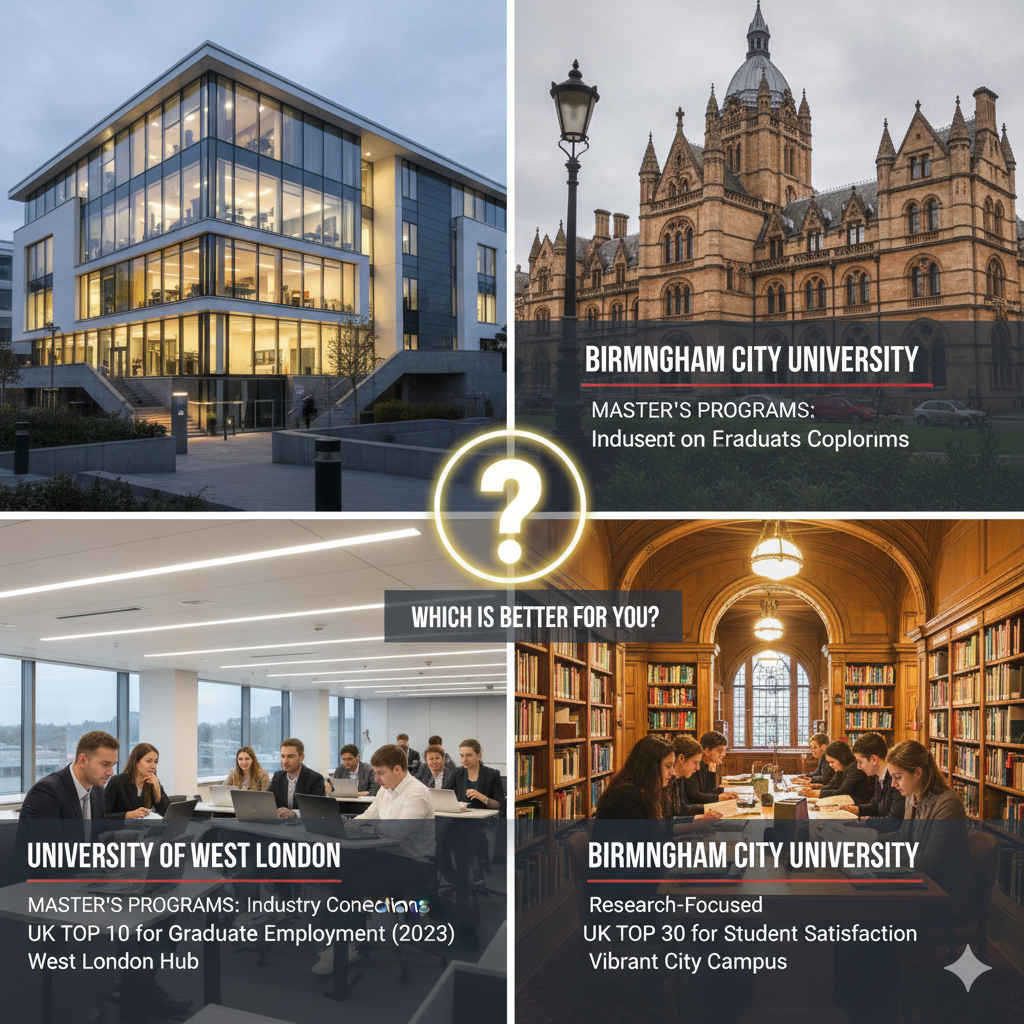
Indian students planning a master’s in the UK often end up putting University of West London (UWL) and Birmingham City University (BCU) side by side. Both are modern, career-oriented universities outside the big Russell Group names, both welcome a lot of international students, and both focus on practical degrees rather than pure academic research. As education consultants who help Indian applicants choose between these and other UK options all the time, we see the decision usually coming down to location, cost, how the courses feel, campus vibe, and what happens after graduation. Neither is clearly “better” in every way, it really depends on what you value most but here are the key differences that help many students decide one way or the other.
Location: London Energy vs Birmingham Calm
UWL is in West London (Ealing and Brentford campuses), so you’re right in one of the world’s biggest job markets. Heathrow is close, central London is 30-45 minutes by tube, and industries like media, business, hospitality, and creative fields are literally on your doorstep. Networking events, internships, part-time work, and guest lectures from London companies are much easier to get to.
BCU is in Birmingham, a big, diverse city but not the capital. It has strong local industry connections (automotive, creative, health), but the job market feels more regional. Birmingham is cheaper and less crowded than London, but you miss that global-hub intensity.
If you want maximum exposure to international companies and that real “London experience,” UWL usually feels more exciting. If you prefer a less hectic city with good local opportunities and lower daily stress, Birmingham often wins.
Tuition Fees and Overall Cost of Living
UWL’s international master’s fees are typically between £13,000 and £17,000 per year (2025/26 figures), depending on the program. Some popular courses (business, computing, media) sit toward the lower end. London living is expensive, but UWL’s campuses are in outer zones, so shared accommodation and transport are more manageable than central London.
BCU fees are similar or sometimes a bit lower £14,000-£16,000 for most taught master’s. Birmingham living costs (rent, food, transport) are clearly cheaper than London. Many students find the total spend (tuition plus living) ends up lower in Birmingham.
For Indian families trying to balance budgets, BCU often feels more comfortable financially. UWL can still work if you’re careful with living expenses or manage to get a scholarship or bursary.
Acceptance Rate and Entry Flexibility
Both universities are known for being relatively accessible compared to elite UK institutions. UWL’s acceptance rate for postgraduate taught programs is generally high (60-75% range for many courses), and they’re flexible with Indian bachelor’s degrees (50-60% marks often enough) and work experience.
BCU is similarly approachable (50-65% acceptance in many programs) and also flexible with Indian qualifications.
Neither is significantly harder than the other both are realistic options for average-to-good profiles. The difference usually comes down to specific course requirements rather than the university itself.
Course Style and Practical Focus
UWL has built a strong reputation in creative and vocational fields music (through London College of Music), media, hospitality, business, computing, and education. Many programs include industry placements, live briefs, or partnerships with London-based employers.
BCU is equally practical and strong in media/production, design, health/nursing, business, and engineering. It has good industry links in the Midlands (automotive, creative, health sectors).
If your field leans toward media, music, hospitality, or London-centric industries, UWL often feels more aligned. If you’re in design, health, or engineering with a Midlands focus, BCU can match or even feel stronger.
Post-Study Work and Job Opportunities
Both qualify for the UK’s two-year Graduate Route visa, same work rights, no difference there.
The real difference is location. UWL graduates have London’s massive job market right there tech, finance, media, consulting, startups. Competition is tough, but the sheer number of opportunities is huge.
BCU graduates benefit from Birmingham’s growing economy (strong in automotive, health, creative), lower living costs while job hunting, and less intense competition than London. Many students find it easier to secure roles quickly in Birmingham.
If you want the broadest possible job market and are okay with higher competition, London (UWL) gives an edge. If you want a more manageable city to start your career, Birmingham (BCU) often feels easier.
Final Thoughts: UWL or BCU for Your Master’s?
There’s no one-size-fits-all answer. Both are solid, career-oriented universities with good support for international students. UWL typically comes out as the best option for those who seek exposure to London, the best creative/media strengths, or the largest job market. On the other hand, BCU is the winner in case one prefers lower living costs, a quieter city, or a particular area of strength in design, health, or engineering.
If London's location and higher acceptance rate fit your needs, apply for the university of east london with high acceptance rate for practical advantages.
If cost of living and a balanced city experience matter more, apply for Birmingham city university in 2026 and check deadlines early.
Always go to the official websites for the latest fees, entry requirements, and course details, things change yearly. The right university is the one that matches your budget, field, and comfort level. Both UWL and BCU give Indian students very achievable paths to a UK master’s.

 Turkish